
Posted by Dever Yang on 13th Mar 2026
The Hidden Cost of Waste in Abrasive Workshops - Observations from Australian Industry
Over the past three years working in Australia, I have visited many customers across different industries — metal fabrication workshops, automotive repair shops, construction contractors, and manufacturing facilities. Through these visits and conversations with technicians, supervisors, and business owners, one issue appears repeatedly: material waste, particularly in abrasive tools used for cutting, grinding, and sanding.
This issue is not unique to one company or sector. It exists across many industries where abrasives are used daily. Because abrasive products are relatively inexpensive consumables, the waste often goes unnoticed in day-to-day operations. However, when viewed over months or years, the accumulated loss can become significant.
Based on what I have observed in workshops, a large portion of this waste does not come from major operational problems, but rather from small and often overlooked details in daily workflow.
Waste Happens in Everyday Workflows
In most workshops, cutting discs, flap discs, and Velcro sanding discs are used continuously throughout the working day. The pace of work is fast, and the priority is completing tasks efficiently.
Because of this, the management of consumables often receives little attention.
For example, a worker may begin cutting steel using a cutting disc. Later, the task requires grinding or finishing, so the worker switches to a flap disc. When cutting is required again, the original cutting disc may no longer be nearby. Instead of searching for it, the worker simply opens a new disc.
The previous disc may still have usable life remaining, but it might be sitting on a workbench, mixed with other tools, or temporarily placed somewhere and forgotten.
This situation is not unusual. It can occur several times during a single shift.
A similar situation occurs with Velcro sanding discs.
These discs are designed for quick replacement when switching grit sizes. While this improves efficiency, it also makes it easier to discard discs prematurely.
In many cases, a sanding disc may still have 30–50% of its usable life remaining, yet it is replaced as soon as cutting performance drops slightly.
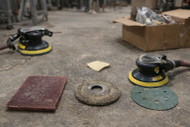
Sometimes when switching to another grit size, the previous disc is simply placed on a workbench or dropped on the floor. Later, when the same grit is needed again, workers often choose to open a new disc rather than search for the previous one.
Individually, these actions seem minor. But across multiple workers and projects, they can result in a considerable amount of unnecessary material consumption.
The Root Cause Is Often the System, Not the Worker
From observation, the root cause of abrasive waste is rarely individual worker behavior alone. More often, it reflects the absence of simple systems for managing consumables.
In many workshops there is no clear separation between:
-
new abrasives
-
partially used abrasives
-
fully worn abrasives
When these items are mixed together, workers cannot quickly identify which tools are still usable. Under time pressure, the easiest solution becomes opening a new one.
In a busy workshop environment, workers naturally prioritize speed and productivity over searching for tools.
Therefore, the issue is usually organizational rather than personal.
Lessons from Lean Management
Many manufacturing companies around the world have addressed similar problems through lean management principles, particularly the well-known 5S system used in Japanese manufacturing.
The five elements of 5S are:
-
Sort
-
Set in order
-
Shine
-
Standardize
-
Sustain
The idea behind lean management is simple: by improving workplace organization and standardizing small operational details, companies can eliminate unnecessary waste and improve efficiency.
In abrasive usage, many of the problems observed in workshops are exactly the type of inefficiencies that lean management aims to address.
When tools and consumables are clearly organized, workers spend less time searching for materials and are less likely to discard usable items.
Lean management does not always require complex systems. In many cases, simple and consistent workplace practices can achieve meaningful improvements.
A Practical Example from an Australian Workshop
During one of my visits to a customer, Park Furniture, I noticed a simple but effective approach to managing abrasive discs.
On one wall of the workshop, they had installed a basic hanging rack where used abrasive discs were placed after use.
These discs were not completely worn out. Many had only been used a few times and still had plenty of usable life remaining. Instead of discarding them, workers simply hung them on the rack.
Whenever the same type or grit was needed again, workers would first check this rack and reuse the discs.
Next to this rack was a separate storage shelf containing brand-new abrasive products and tools.
This arrangement created a very clear and intuitive system:
-
one location for reusable discs
-
another location for new abrasives
Without complicated rules or supervision, workers naturally followed the system. As a result, discs were often reused several times before being discarded.
The solution was simple, inexpensive, and highly practical.
Small Improvements Can Deliver Real Savings
In many workshops, abrasive waste is not caused by carelessness or poor work ethic. More often, it results from small operational details that have never been standardized.
Fortunately, solving these issues does not require complicated systems. Often, a few simple practices can significantly reduce unnecessary consumption.
Please consider the simple suggestions from Abrasivestocks.
-
clearly separating new abrasives and used but reusable discs
-
setting up a designated storage location for partially used discs
-
ensuring abrasive discs are not placed on the floor, where dust and debris can contaminate them
-
organizing sanding discs by grit or type, so workers can quickly find what they need
-
maintaining simple daily habits such as returning tools to their proper place
These measures may seem small individually. However, when applied consistently across a workshop, they can significantly reduce waste and improve efficiency.
In industries where consumables like abrasives are used every day, attention to operational detail often translates directly into cost control.


