
Posted by Abrasivestocks on 31st Oct 2026
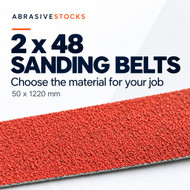
50 x 1220 mm Sanding Belts: Choosing the Material for Your Job
A replacement belt can be the right size and still be the wrong choice for the job. If your workshop uses a 2 x 48 belt sander, start with the machine's specified dimensions, then choose an abrasive for the material and the amount of work you need it to do.
This guide explains how to approach the Abrasivestocks 50 x 1220 mm sanding belt range without buying a collection of grades you will rarely use.
Check the machine before choosing the material
The product is listed as 50 x 1220 mm (2 x 48 inch). Inch names are commonly used as nominal size labels; check the dimensions and permitted belt specification in your machine manual rather than assuming every belt described as 2 x 48 is interchangeable.
Read the marking on your existing belt, confirm its width and full loop length, and check the machine's tension adjustment. If the label has worn away, our guide to measuring sanding belt size explains the measurement process. A longer or wider belt is not a useful substitute simply because it almost fits.
Choose for the work, not just the grit number
Two belts marked with the same grit can behave differently because the abrasive, backing and construction differ. Describe the task first: removing material, refining scratches, blending a surface or polishing an already prepared part.
Zirconia: a starting point for metalworking
Consider a suitable zirconia belt for metal removal, deburring and initial scratch refinement. Choose a coarser grade when the starting surface requires substantial correction, then move finer as the surface becomes more uniform. The right starting grit depends on the depth of the marks and how much material you can remove.
Ceramic: consider the machine and contact conditions
Ceramic is another option for metal grinding and demanding removal work. It should be selected alongside the machine's capability and the contact conditions. The word ceramic alone does not establish a particular cutting rate or belt life. For a new application, try a suitable grade on a sample before committing to a larger refill.
Structured abrasive: plan the refinement stage
PYTAMID structured abrasive options are intended for progressive scratch refinement and finishing. Use them after the earlier scratches have been reduced sufficiently. Switching straight from deep grinding marks to a very fine finishing belt can leave the original marks visible. Structured abrasive grade descriptions should not be treated as automatic equivalents to every conventional grit system.
Non-woven: think surface conditioning
Non-woven conditioning belts serve a different role from a coarse grinding belt. Consider them for blending and developing an appropriate surface appearance after preparation. A colour-labelled conditioning grade is not an exact conversion to a numbered coated-abrasive grit. Match the selected material and finishing grade together.
Build a small, useful refill
Start with the stages your work actually requires. For example, a metal part with visible scratches may need an initial removal stage, one or more refinement stages, and a separate conditioning step if the intended result is a satin appearance. A cleaner starting surface may need fewer stages.
Inspect the surface between changes. Move on when the previous scratch pattern has been replaced consistently, rather than following a fixed sequence regardless of the result. Keep a note of the belt material, grade and workpiece so your next order is based on a process you have checked.
Before adding belts to your order
- Confirm the machine accepts the listed 50 x 1220 mm format.
- Select the abrasive material first, then a compatible grit or finishing grade.
- Check the selected combination's availability and current price; the range does not mean every material is supplied in every grade.
- Check the stated pack quantity and your order quantity rather than assuming a gallery photo shows the supplied number.
- Follow the machine and belt operating instructions, including applicable speed limits and dust-control requirements.
Ready to choose? Browse the 50 x 1220 mm sanding belts. If you are unsure, send our Australian team your machine model, workpiece material, starting surface and desired finish. Those details help us recommend a suitable material and grade without guessing.


