
Posted by Dever Yang on 27th May 2026
How to Choose the Right Abrasive Belt for Industrial Grinding and Polishing
Over the past few years, while visiting industrial customers across Australia, attending workshops, factories, and speaking with users almost every day, I found one thing happens again and again — many customers still feel confused when choosing the correct sanding belt.
Sometimes the discussion starts from a simple phone call about grinding stainless steel, but finally turns into a long conversation about ceramic, zirconia, silicon carbide, polishing finish, belt life and production cost.
After answering similar questions so many times, I thought maybe it is better to simply write one article and share some practical experience with everyone.
In the abrasive industry, many users still select sanding belts only by grit size. Actually, grit is only one small part of the full grinding system. Different abrasive grains, backing materials, coating structures, and production technologies will directly affect cutting speed, surface finish, heat generation, belt life, and even total production cost.
After working with abrasive products and industrial users for many years in Australia and international markets, we found that choosing the correct abrasive belt can improve efficiency much more than simply increasing machine power or changing operators. Many factories lose time and money because they are using the wrong abrasive belt for the wrong material.
This article shares some practical understanding about common abrasive belt materials and where they are normally used in real industrial production.
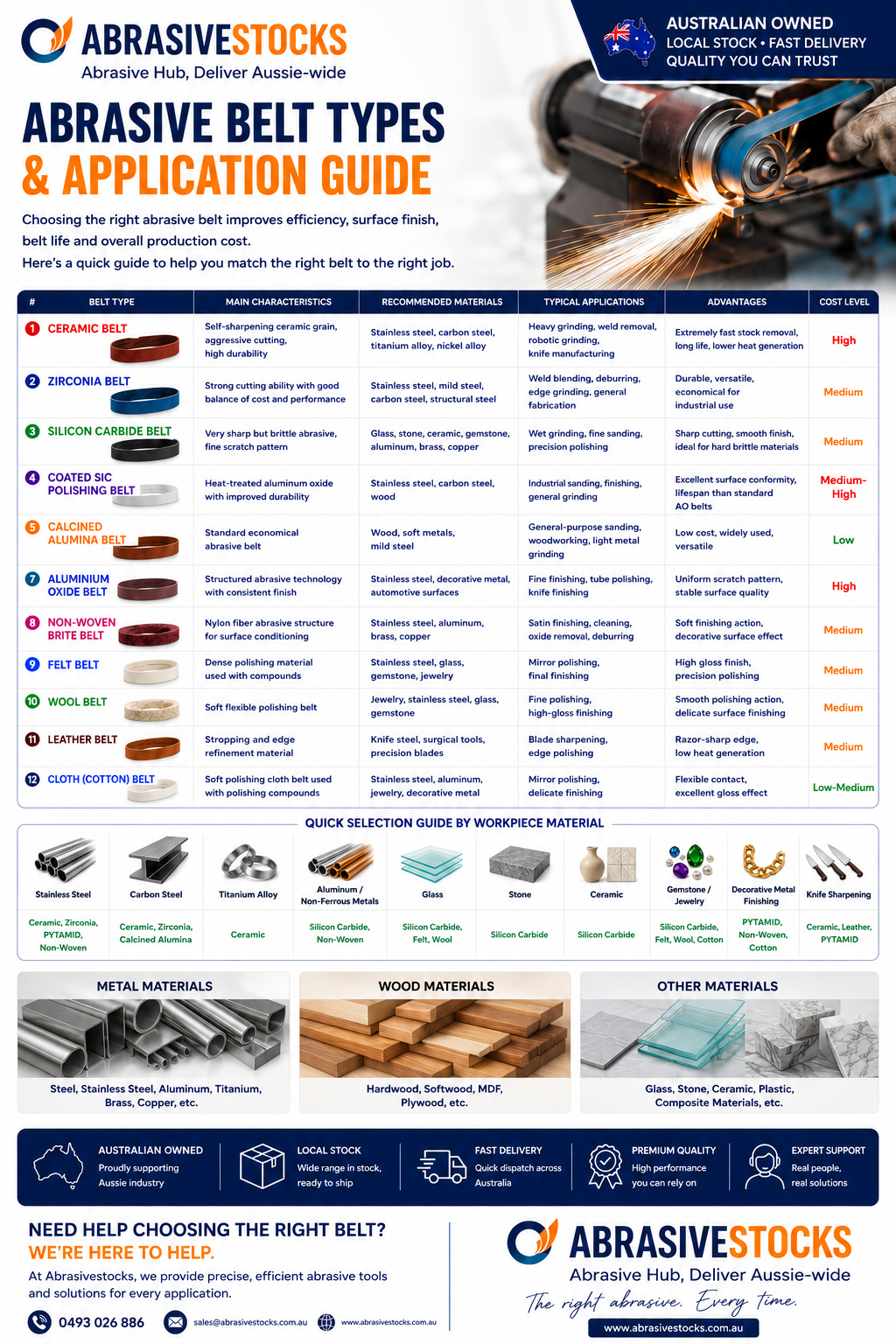
Ceramic Abrasive Belt
Ceramic abrasive belts are now one of the most powerful grinding belts in heavy industrial applications. Ceramic grain is designed with self-sharpening performance. During grinding, the abrasive fractures continuously and exposes new sharp edges again and again.
Because of this, ceramic belts keep cutting aggressively even under high grinding pressure.
Ceramic belts are widely used for:
-
Stainless steel grinding
-
Titanium alloy
-
Nickel alloy
-
Heavy weld removal
-
Robotic grinding
-
Knife manufacturing
-
Metal fabrication industry
One big advantage of ceramic belts is lower grinding temperature compared with ordinary aluminum oxide belts. This helps reduce heat discoloration on stainless steel and improves grinding consistency.
In our experience, ceramic belts are especially suitable for factories that require high stock removal and stable long-term performance. Although ceramic belts cost more at the beginning, the overall grinding cost is often lower because the lifespan is much longer.
For heavy grinding applications, ceramic is usually the first recommendation.
Zirconia Abrasive Belt
Zirconia belts are probably one of the most popular choices for general metal fabrication workshops. They provide a very good balance between performance and cost.
Compared with ceramic belts, zirconia is slightly less aggressive, but still delivers strong cutting ability and good durability.
Common applications include:
-
Mild steel
-
Carbon steel
-
Stainless steel
-
Structural steel
-
Weld blending
-
Deburring
-
Edge grinding
Many portable belt sanding machines in fabrication workshops use zirconia belts because they work well under medium to high pressure.
For companies looking for better cost performance instead of maximum grinding speed, zirconia abrasive belts are often a smart choice.
Silicon Carbide Abrasive Belt
Silicon carbide (SiC) abrasive is very sharp but also brittle. It cuts fast and creates very fine scratch patterns.
Unlike ceramic or zirconia, silicon carbide is usually not designed for heavy grinding on steel. Instead, it performs much better on hard or non-metallic materials.
Typical applications include:
-
Glass polishing
-
Stone grinding
-
Ceramic materials
-
Gemstone processing
-
Aluminum
-
Brass
-
Copper
-
Fiberglass
Silicon carbide belts are also widely used in wet grinding applications because they provide cleaner surface finishing.
One thing many users misunderstand is using silicon carbide belts on stainless steel heavy grinding. In most cases, the grain breaks too quickly and belt life becomes very short.
Coated SiC Soft Polishing Belt
Soft polishing belts with silicon carbide coating are mainly used for fine surface finishing rather than aggressive grinding.
Because the backing is flexible, the belt can better follow curved surfaces and irregular shapes.
These belts are commonly used for:
-
Decorative stainless steel finishing
-
Mirror polishing
-
Glass edge polishing
-
Stone polishing
-
Curved surface treatment
The grinding pressure becomes softer and smoother, helping improve finishing consistency.
In decorative metal industries, these belts are often used during the final polishing stages.
Calcined Alumina Belt
Calcined alumina is heat-treated aluminum oxide with improved toughness and heat resistance.
Compared with ordinary aluminum oxide belts, calcined alumina provides:
-
Longer belt life
-
Better heat resistance
-
More stable grinding
-
Improved cutting performance
These belts are widely used for:
-
Stainless steel finishing
-
Carbon steel grinding
-
Woodworking
-
General industrial sanding
For many users, calcined alumina becomes a good middle option between low-cost aluminum oxide and expensive ceramic abrasive belts.
Aluminium Oxide Belt
Aluminium oxide abrasive belts are still the most common and economical sanding belts in the market.
They are suitable for:
-
Wood sanding
-
Soft metals
-
Mild steel
-
Light industrial grinding
-
General purpose sanding
The biggest advantage is low cost and wide availability.
However, compared with ceramic and zirconia, ordinary aluminium oxide belts usually have:
-
Shorter lifespan
-
Lower grinding efficiency
-
Faster heat generation
For simple applications and cost-sensitive jobs, they still remain a practical solution.
PYTAMID Structured Abrasive Belt
PYTAMID belts use structured abrasive technology with uniform abrasive patterns across the belt surface.
During grinding, the abrasive wears evenly, helping maintain a stable surface finish from beginning to end.
These belts are widely used for:
-
Decorative stainless steel
-
Automotive finishing
-
Tube polishing
-
Knife finishing
-
Fine metal polishing
The biggest advantage is finish consistency.
For industries where appearance quality is important, structured abrasive belts help reduce finishing variation between different operators and production batches.
Non-Woven Brite Belt
Non-woven abrasive belts use nylon fiber combined with abrasive grain.
Unlike traditional grinding belts, they are designed more for surface conditioning and decorative finishing.
Applications include:
-
Satin finishing
-
Surface blending
-
Oxide removal
-
Cleaning
-
Light deburring
Suitable materials include:
-
Stainless steel
-
Aluminum
-
Copper
-
Brass
These belts are commonly used before mirror polishing or coating processes.
One important advantage is that non-woven belts create a very uniform surface texture without removing excessive material.
Felt Belt and Wool Belt
Felt belts and wool belts are polishing products instead of grinding products.
Normally they are used together with polishing compounds or diamond paste.
Typical applications:
-
Stainless steel mirror polishing
-
Jewelry polishing
-
Glass polishing
-
Gemstone polishing
Wool belts are softer and more flexible, while felt belts provide firmer polishing pressure.
For mirror finishing applications, these belts are still very important in final production stages.
Leather Belt
Leather belts are mainly used for stropping and ultra-fine edge polishing.
Common applications include:
-
Knife sharpening
-
Surgical tools
-
Precision cutting tools
Leather polishing generates very low heat and helps produce extremely sharp edges.
This is why leather belts remain popular in knife manufacturing and sharpening industries.
Cotton Cloth Polishing Belt
Cotton polishing belts are flexible polishing belts used together with polishing compounds.
They are widely used for:
-
Jewelry polishing
-
Decorative stainless steel
-
Aluminum polishing
-
Fine surface finishing
The soft contact surface helps reduce vibration and improves mirror finishing quality.
For delicate surfaces, cotton belts are often preferred over harder polishing materials.
How to Choose the Correct Abrasive Belt
Choosing the right abrasive belt depends on several important factors:
-
Workpiece material
-
Surface finish requirement
-
Grinding pressure
-
Machine speed
-
Production efficiency
-
Cost target
-
Operator experience
In real industrial production, there is no single belt suitable for all applications.
For example:
-
Heavy stainless steel grinding normally requires ceramic belts
-
General fabrication may use zirconia belts
-
Glass and stone usually require silicon carbide
-
Decorative finishing often uses structured abrasive or non-woven belts
-
Mirror polishing requires felt, wool, leather, or cotton polishing belts
In many factories, multiple abrasive belts are used step by step — from aggressive grinding to fine polishing — to achieve the best balance between efficiency, finish quality, and production cost.
At Abrasivestocks Australia, we always believe the correct abrasive solution is not simply about selling the cheapest belt. The real value comes from helping users improve grinding performance, reduce downtime, increase consistency, and build a more stable production process for long-term manufacturing success.
Sometimes the cheapest abrasive belt finally becomes the most expensive one in the workshop.
Also, all of our regular industrial customers purchasing sanding belts from Abrasivestocks Australia may receive complimentary Sanding Belt Cleaning Sticks together with selected orders, helping extend belt life and improve grinding consistency during production.


