
Posted by Abrasivestocks on 3rd Nov 2026
Choosing a Pipe Polisher for Handrails: Check the Access First
You can measure the diameter of a stainless handrail and still miss the detail that decides whether a pipe polisher will work on it: the space around the rail. A clear straight tube on a bench is a different proposition from an installed rail beside a wall, bracket or upright.
Before choosing a HIJOHNY pipe polisher, look at where the abrasive needs to reach and where the machine itself will sit. This guide helps you prepare those details before ordering a stainless tube polishing machine.
Check the tightest section, not just the easiest one
Walk along the whole job and identify the awkward spots. These might be the underside of a rail, a return near a wall, an elbow or a short section between two supports. Take a clear photograph of each difficult area rather than sending only a close-up of the tube.
Record the tube outside diameter and the free space around it. Include the distance to the wall and any nearby brackets. These are separate measurements: a suitable tube diameter does not, by itself, confirm that the polisher's head, body and handles can move through the required area.
Think about the head and the rest of the machine
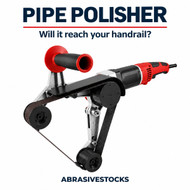
The abrasive contact area is only part of the space a pipe belt sander occupies. Look at the wheel arrangement, the frame around the belt, the drive body and the handle positions. Consider the position you would need to hold while following the tube.
For example, our HIJOHNY 1100W three-wheel pipe polisher is specified for 40 × 760 mm belts. That identifies the model's belt format; it does not promise clearance around every installed handrail. Compare the actual head geometry with the restricted parts of your job before choosing it.
Do not assume that changing an attachment or fitting another belt will solve an access problem. Confirm that the head and consumable are intended for the particular machine configuration.
Decide which surfaces actually need finishing
Does the job require a consistent visible grain around the complete circumference, or mainly on the exposed face? Is the area close to a joint part of the agreed finish? Identifying the required surfaces makes it easier to discuss access and avoids choosing a machine around an incomplete picture of the work.
A pipe polisher may suit the open sections while a restricted detail needs a separately planned method. Do not force a machine into a position that prevents the grip, control or operating clearance required by its instructions.
Keep access and abrasive selection as two checks
Once the machine can reach the work, choose the abrasive for the starting surface and target appearance. Removing a clear scratch and blending an already suitable surface are different stages. Our pipe-polishing guide to cutting and conditioning belts explains that distinction.
For the three-wheel model linked above, the 40 × 760 mm replacement belt page lets you check materials and compatible grades. Select the combination and check the displayed quantity before ordering. Other heads may need different dimensions; a shared width is not enough to establish compatibility.
Send us a useful handrail enquiry
A short set of details is more useful than asking whether a machine can polish “standard handrail”. When you contact the Abrasivestocks team, include:
- The tube material and outside diameter.
- Whether it is a loose workpiece or an installed handrail.
- Photographs showing the rail, nearby supports and the tightest gap.
- The marks to remove and the finish you want to match.
- The HIJOHNY model or head you are considering.
We can then discuss the product specification against the information you provide, rather than guessing from a tube diameter alone. Check the machine's operating instructions and the selected abrasive's requirements before use. A clear access check is a useful first step towards choosing the right pipe polisher for your workshop or installation job.


