
Posted by Abrasivestocks on 2nd Nov 2026
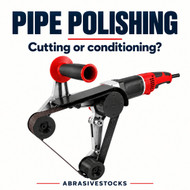
Pipe Polishing: Coated Abrasive or Non-Woven Belts?
A stainless handrail can be free of heavy scratches yet still look patchy. Another tube may have a tidy-looking grain but a weld mark that needs more work. Those are different jobs. Choosing the belt for the next job, rather than simply choosing a finer-looking product, helps you get more from your HIJOHNY pipe polisher.
For the HIJOHNY 1100W three-wheel pipe polisher, the specified belt format is 40 mm wide × 760 mm full loop length. Once the fit is confirmed, decide whether you need to remove material or condition the surface.
Start with the tube, not the belt colour
Look at a clean section under consistent light. Are you dealing with a raised weld, distinct scratches, an uneven sanding pattern or a surface that mainly needs a more uniform satin appearance? Also decide which existing finish you need to match. A useful target is a sample approved for that job; a photograph on a screen is a less reliable reference.
Deep defects generally need a cutting stage before finishing. A surface-conditioning belt can blend a suitable surface, but should not be treated as a shortcut for levelling every weld or removing every deep scratch.
Coated abrasive belts: establish and refine the surface
Coated belts carry abrasive grain on a backing. In a pipe-polishing workflow, they are a practical choice for material removal and controlled scratch refinement. Abrasivestocks lists zirconia and ceramic options among its 40 × 760 mm pipe-polisher belts, alongside other materials for different stages.
Choose the starting grit for the actual defect and the amount of material you can remove. Beginning unnecessarily coarse creates extra scratches to refine; beginning too fine can leave the original marks visible. Test a small representative area, inspect it, then select the next step. There is no single grit sequence that suits every tube, weld and finish requirement.
Non-woven belts: blend and condition
Non-woven abrasive belts use an open fibrous structure containing abrasive. Their role includes cleaning, blending and surface conditioning. For stainless tube work, they can be useful when the cutting marks are already suitable and the remaining task is to even out the appearance.
A satin finish is different from a mirror finish. Do not order a non-woven belt expecting it to deliver every polishing stage on its own. The starting surface, the particular grade and the way the belt contacts the tube all affect the result.
Colour labels such as maroon are not universal numbered-grit equivalents. Compare the supplier's stated material and grade, and confirm the selected combination on the product page. Do not assume that the same colour from two manufacturers will produce an identical finish.
A simple way to plan the next belt change
- Define the target: identify the finish you need to match and the defects that remain.
- Complete the cutting stage: refine the earlier scratches sufficiently before moving to surface conditioning.
- Trial the finishing grade: inspect the sample beside the adjacent tube in the same light.
- Record the useful combination: note the machine head, belt size, material, grade and working method for repeat jobs.
Follow the machine and belt manufacturers' operating instructions and speed limits. Keep abrasives used on carbon steel separate from those used for stainless work. Appearance alone does not establish a certified surface roughness or corrosion performance.
Order for your HIJOHNY head and your finishing task
The three-wheel model linked above uses 40 × 760 mm belts; other HIJOHNY heads can use different dimensions. Check our HIJOHNY pipe-polisher belt size guide before ordering for another head. Matching width alone is not enough.
On the replacement-belt page, select the material first, then a compatible grit or conditioning grade. Check the displayed combination and quantity: not every material is offered in every grade, and an individual-belt listing is different from a multipack.
Not sure which stage your tube needs? Ask the Abrasivestocks team with your machine model, belt dimensions, workpiece material and target finish. That gives us a useful starting point for helping you choose a suitable refill.


