
Posted by Dever Yang on 25th Aug 2026
What Is a PYTAMID Belt? How Structured Abrasives Work
Why Does It Look Coarse but Produce Such a Fine Finish?
When customers see a PYTAMID Belt for the first time—especially under magnification—they sometimes ask an understandable question:
“Why do the abrasive structures look so large if this is a fine-finishing belt?”
The answer is simple but important:
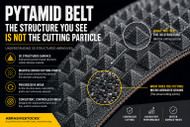
What you can see is the abrasive structure — not the size of an individual cutting particle.
This distinction is the key to understanding how a PYTAMID Belt works.
Unlike a conventional coated abrasive belt, where individual abrasive grains are distributed across the backing, a PYTAMID Belt uses precisely formed three-dimensional abrasive structures.
These raised structures may look relatively large to the naked eye or under a low-power microscope. However, each structure contains many much smaller abrasive cutting points.
The visible pyramid-shaped structure is therefore not one giant abrasive grain.
It is a controlled abrasive structure containing fine abrasive material designed to wear and cut progressively.
What Does “PYTAMID” Mean?
PYTAMID™ is the Abrasivestocks brand for our range of structured abrasive products.
The name reflects the distinctive pyramid-like three-dimensional structures formed across the abrasive surface.
Instead of simply coating loose abrasive grains onto a backing, the abrasive material is formed into thousands of regularly arranged structures.
This creates a very different cutting mechanism from a conventional coated abrasive.
Think of it this way:
Conventional abrasive belt: individual abrasive grains form the cutting surface.
PYTAMID Belt: engineered abrasive structures contain and continuously expose fine cutting points.
That difference is fundamental.
Large Structure Does Not Mean Large Grit
This is probably the most important point to understand about PYTAMID.
When examining a very fine conventional abrasive—such as a fine silicon carbide belt—the surface may appear extremely smooth. The abrasive coating can look almost like a thin, uniform layer.
A PYTAMID Belt looks completely different.
Even at 40× magnification, the repeating raised structures can be clearly visible.
This can create the impression that the abrasive must be coarse.
But this conclusion comes from confusing two different things:
structure size and abrasive particle size.
They are not the same.
The large feature you see is a three-dimensional carrier structure containing abrasive material. The actual cutting action occurs through much smaller abrasive cutting points within and on the surface of these structures.
Therefore:
Do not judge the finishing capability of a structured abrasive simply by how large its surface structures appear.
The appearance of the structure does not directly tell you how deep the resulting scratch will be.
How Does a PYTAMID Belt Cut?
The operating principle is based on controlled, progressive wear.
At the beginning of use, the uppermost portions of the abrasive structures contact the workpiece.
These surfaces contain many microscopic cutting points.
As polishing or sanding continues, the exposed abrasive gradually wears. Instead of the belt simply becoming smooth and losing its cutting ability, progressive wear of the structured abrasive exposes additional abrasive material.
In simplified terms:
Cut → Wear → Expose → Cut Again
This progressive process helps maintain a more controlled cutting action throughout the useful life of the belt.
The abrasive structure is therefore not designed to remain physically unchanged.
Controlled wear is part of how the product works.
Why Can PYTAMID Produce a Fine and Consistent Finish?
Surface finish is not determined only by what an abrasive looks like.
What matters is what happens at the microscopic contact area between the abrasive and the workpiece.
Important factors include:
-
the size and characteristics of the actual cutting points;
-
how those cutting points are distributed;
-
how consistently they contact the workpiece;
-
how the abrasive structure wears;
-
how new cutting points become exposed;
-
applied pressure and belt speed;
-
the material being processed; and
-
the previous scratch pattern on the workpiece.
The structured surface of PYTAMID is designed to make this cutting process progressive and predictable.
This is particularly valuable when the objective is not aggressive material removal, but scratch refinement and controlled surface finishing.
Conventional Abrasive vs. PYTAMID Structured Abrasive
A conventional coated abrasive normally consists of individual abrasive grains bonded to a backing.
Those exposed grains perform the cutting.
As they wear, fracture or become dull, the cutting characteristics of the belt can change.
PYTAMID takes a different approach.
Instead of relying only on individually exposed grains, the abrasive is incorporated into regularly formed three-dimensional structures.
This means the belt should not be evaluated only by asking:
“How fine do the grains look?”
A better question is:
“What scratch pattern and surface finish does this belt actually produce?”
For finishing applications, the result on the workpiece is more meaningful than the apparent size of the visible abrasive structures.
Why PYTAMID Is Useful for Multi-Step Finishing
One of the biggest advantages of structured abrasives is the ability to create a more controlled finishing sequence.
Instead of trying to jump directly from coarse grinding to polishing, different PYTAMID grades can be used progressively to reduce the scratch pattern.
The basic principle is:
Remove the scratches from the previous step → create a finer, more uniform scratch pattern → repeat until the required finish is achieved.
This makes PYTAMID particularly useful for applications such as:
-
stainless steel finishing;
-
knife and blade finishing;
-
metal fabrication;
-
tube and pipe polishing;
-
aluminium finishing;
-
precision surface preparation;
-
scratch refinement;
-
satin and fine finishing; and
-
preparation before final polishing.
Do Not Compare Structured Abrasives by Appearance Alone
This is especially important when comparing PYTAMID with conventional fine abrasive belts.
A conventional fine abrasive may look smoother, thinner and visually “finer.”
A PYTAMID Belt may look thicker and more textured because you are seeing its engineered three-dimensional abrasive structures.
They use different abrasive architectures.
For this reason, visual appearance alone is not a reliable way to determine which belt will produce the finer or more suitable finish.
The best evaluation is a controlled sanding test on the actual material.
Compare:
the scratch pattern, surface uniformity, cutting consistency and final finish.
The workpiece tells you much more than the appearance of the belt.
The Simplest Way to Understand PYTAMID
If you remember only one thing from this article, remember this:
The pyramid you see is the structure — not a single abrasive grain.
Inside and across that structure are much smaller abrasive cutting points.
As the structured abrasive works and wears progressively, additional cutting material is exposed.
That is why a PYTAMID Belt can have a visibly pronounced three-dimensional surface while still being designed for fine, controlled and consistent surface finishing.
PYTAMID™ Structured Abrasive Belts
PYTAMID™ is developed for users who require more than simple material removal.
It is designed for controlled scratch refinement, repeatable finishing and progressive surface improvement across multiple finishing stages.
When selecting a PYTAMID grade, don't judge the belt only by how coarse or fine the surface looks.
Judge it by the finish it produces.
PYTAMID™
Structured Abrasives. Controlled Cutting. Consistent Finishing.
PYTAMID™ is an Abrasivestocks structured abrasive product range.


