
Posted by Abrasivestocks on 1st Nov 2026
Pipe Polisher or Belt Sander? Choose the Right Tool for Stainless Tube
A straight section of stainless tube can look simple to finish—until you try to produce an even scratch pattern around its curved surface. The abrasive needs to reach the area you are working on, stay under control and leave a finish that matches the surrounding metal.
That is where choosing between a pipe polisher and a conventional belt sander becomes useful. Both use abrasive belts, but the shape of the workpiece and the way you need to reach it should guide the purchase.
Start with the workpiece
For flat surfaces, edges and bevels, a belt sander with a suitable platen or contact wheel can provide a useful working surface. Depending on the machine, it may suit shaping parts, refining edges or preparing knife blanks.
Round tube presents a different challenge. You are working around a curve, sometimes near a bend, bracket or welded connection. A pipe polisher uses a belt arrangement intended to work against curved surfaces, making it a relevant option for tube and handrail finishing.
Before comparing motor power or accessories, ask a more practical question: can this machine reach the area I need to finish?
Consider the tube diameter, clearance around the workpiece and whether you are finishing loose tube on a bench or an assembled component. Check the individual model's specifications rather than assuming every pipe polisher handles the same work.
Belt size matters beyond the first purchase
A machine is only part of the finishing system. You also need replacement belts in the correct dimensions and suitable abrasive specifications.
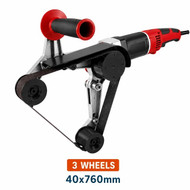
For example, the HIJOHNY 3-Wheel Pipe Polisher uses 40 × 760 mm belts and has an 1100W variable-speed motor. Its product page lists 10 sanding belts included.
Those details give you a starting point for comparing the machine with another package. You should still confirm the selected configuration and supplied abrasive details before ordering.
Already own a machine? Read the belt dimensions from its documentation or existing belt markings. A familiar-looking head or similar machine name does not establish compatibility. Our HIJOHNY pipe polisher belt-size guide helps you check the different formats.
Choose the abrasive for the stage of work
Buying a pipe polisher does not mean using one belt for every operation.
A coated abrasive belt may be appropriate when you need to remove material or refine scratches. A suitable non-woven belt may be useful at a later surface-conditioning stage. These are different jobs: a finishing belt should not be expected to remove a deep defect simply because it produces a finer-looking surface.
Start by identifying what needs to change:
- Are you removing an existing scratch or blending an uneven area?
- Are you refining marks left by the previous abrasive?
- Are you trying to match an existing satin finish?
Then select a compatible belt and trial the process on a suitable sample. The abrasive material, grade, machine settings and technique all contribute to the result.
For machines specified to use that size, our 40 × 760 mm sanding belt range provides material and grade options to check before purchasing.
Compare what you will actually receive
Two pipe polisher packages can have similar photographs and different inclusions.
Check whether the listing supplies a complete powered machine, an attachment or a package with interchangeable heads. Confirm the belt size, included belt quantity and available replacement consumables.
Motor wattage is one comparison point. Access to the work, handling, abrasive choice and clear package contents also deserve attention. A useful purchase is a machine you can match to your work and continue supplying with the right belts.
Get help matching the machine to the job
If you are choosing a pipe belt sander for stainless tube or handrails, send us the tube diameter, a photograph showing access around the workpiece and the finish you want to achieve.
Already have a polisher? Include the machine model and belt dimensions.
Contact Abrasivestocks for help with pipe polisher and belt selection, or browse the pipe polisher range to compare the individual configurations.


